The Africa Think Tank Platform
A continental hub connecting governments, think tanks, and researchers to generate evidence-based knowledge for cross-boundary policy priorities across all 55 AU member states.
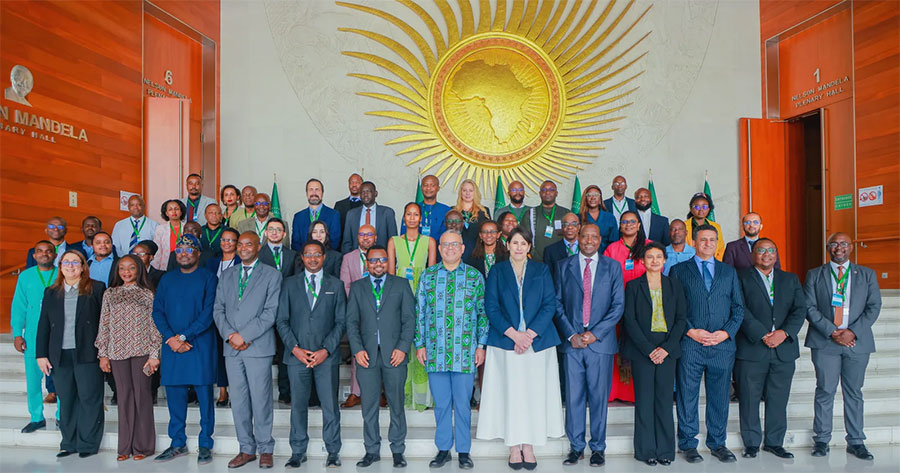
Partners




Capacity to bridge policy research and African governance
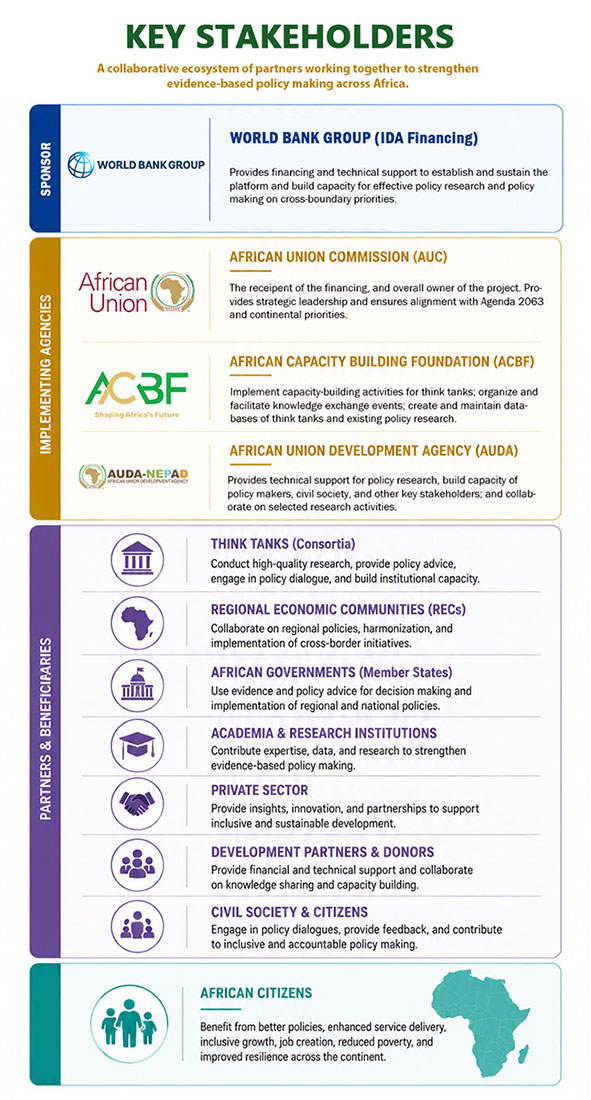
The Africa Think Tank Platform (ATTP) is a $50 million, five-year initiative funded by the World Bank's International Development Association (IDA) and implemented through the African Union Commission (AUC), with ACBF as a key specialized implementing agency.
ATTP aims to establish a sustainable continental platform that connects governments, think tanks, academic institutions, regional economic communities (RECs), and development partners to generate and apply evidence for cross-boundary policy challenges.
"To establish a sustainable platform to strengthen the capacity for effective policy research and policy making on cross-boundary priorities in Africa."
Less than 10% of continental policies and agreements are adopted at national level due to weaknesses in the policy formulation cycle. ATTP directly addresses this by connecting researchers to where decisions are made.
How the project is structured
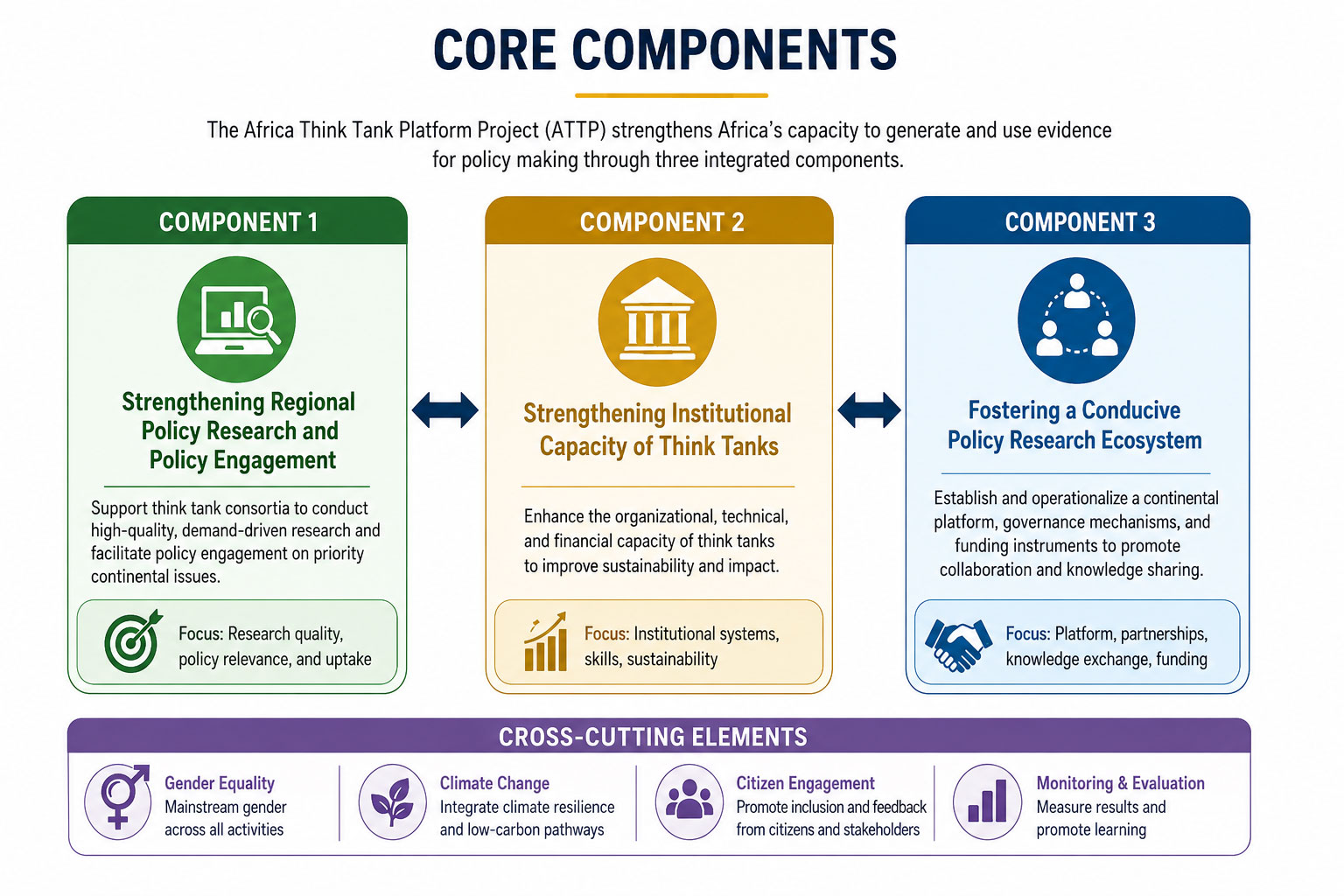
The project operates through three interlocking components totalling US$50 million, running from 2023 to 2028.
Establish capacity to operate a sustainable policy making platform
Sets up the institutional infrastructure: secretariat, Think Tank Platform Steering Committee (TTPSC), M&E systems, and the continental network of think tanks and policy makers.
US$3.5 million
Strengthen quality, relevance and uptake of policy research
Core research funding to competitively selected think tank consortia across 6 priority themes, knowledge exchange events, fellowships, Africa Knowledge Repository, and capacity building.
US$35.5 million
Support platform sustainability
Establishes a Special Fund and a US$10 million seed Endowment Fund to crowd in resources from African governments, private sector, foundations and institutional donors beyond the WB grant period.
US$11 million
Thirteen funded projects
The Africa Think Tank Platform (ATTP) is a flagship, five-year, US$50 million initiative of the African Union, financed by the World Bank Group (IDA) and implemented by the African Union Commission (AUC) in partnership with the African Capacity Building Foundation (ACBF) and the African Union Development Agency (AUDA-NEPAD). ATTP was established to build a sustainable, continent-wide platform connecting Africa's think tanks, policymakers, Regional Economic Communities (RECs), and development partners, ensuring that Africa's policy landscape is shaped by rigorous, locally generated evidence rather than externally driven research agendas.
Through a competitive, merit-based selection process launched in July 2025, the African Union Commission signed grant agreements with 13 African think tanks, organised into three pan-African research consortia, in April 2026. A total of US$24.2 million is being disbursed in phases across these consortia to strengthen institutional capacity, drive collaborative research, and produce policy-ready solutions to Africa's most pressing cross-border development challenges.
Together, the three consortia span West, East, North, Central, and Southern Africa, and work across six strategic thematic areas aligned with Agenda 2063:
- Economic Transformation and Governance
- Regional Trade
- Climate Change
- Food Security
- Human Capital Development
- Digitalization
| Consortium | Region Covered |
|---|---|
| RAISED-Africa | North, East & West Africa |
| BRIDGE-Africa | West, Central, Southern, East & North Africa |
| CACEPS | East, North, West & Southern Africa |
By channelling resources directly to African-led research institutions, ATTP represents a decisive shift toward home-grown, continent-driven solutions, helping AU Member States and RECs translate continental commitments into tangible national and regional outcomes.
RAISED-Africa
Research Alliance for Inclusive and Sustainable Economic Development
Led by the Economic Research Forum (ERF), based in Egypt, RAISED-Africa brings together researchers with deep expertise on North African and broader continental economic policy issues, focusing on inclusive and sustainable economic development pathways for Africa.
| Think Tank | Country | Role |
|---|---|---|
Economic Research Forum (ERF)  | Egypt | Lead Institution |
Partnership for Economic Policy (PEP)  | Kenya | Consortium Member |
Environmental and Economic Resource Centre (EERC)  | Nigeria | Consortium Member |
BRIDGE-Africa
Building Resilience and Impact through Dialogue and Galvanising Action for Evidence-Informed Policymaking
Coordinated by the African Center for Economic Transformation (ACET), based in Ghana, BRIDGE-Africa is a pan-African consortium specializing in economic transformation policy analysis, with strong representation across Central, Southern, and North Africa.
Within BRIDGE-Africa, SAIIA leads the research agenda on climate change, focusing on scaling adaptation finance and developing green mineral value chains, illustrating how member institutions take on differentiated thematic leadership roles within a shared consortium mandate.
| Think Tank | Country | Role |
|---|---|---|
African Center for Economic Transformation (ACET)  | Ghana | Lead Institution |
Nkafu Policy Institute, Denis & Lenora Foretia Foundation  | Cameroon | Consortium Member |
African Institute for Development Policy (AFIDEP)  | Kenya | Consortium Member |
South African Institute of International Affairs (SAIIA)  | South Africa | Consortium Member |
Policy Center for the New South  | Morocco | Consortium Member |
CACEPS
Consortium for Africa Cross-Border Evidence and Policy Sovereignty
Led by the African Population and Health Research Center (APHRC), based in Kenya, CACEPS focuses on generating cross-border evidence to strengthen African policy sovereignty, with the continent's broadest linguistic representation among the three consortia.
IPAR (Senegal) is CACEPS' only Francophone member and just the second Francophone institution across all of ATTP, giving it a distinct role in voicing Francophone African research and policy perspectives within continental debates. IPAR specializes in agricultural, rural, and food-security policy across eleven West African countries.
| Think Tank | Country | Role |
|---|---|---|
African Population and Health Research Center (APHRC)  | Kenya | Lead Institution |
Egyptian Center for Economic Studies (ECES)  | Egypt | Consortium Member |
Centre for Population and Environmental Development (CPED)  | Nigeria | Consortium Member |
Centro de Integridade Pública (CIP)  | Mozambique | Consortium Member |
Initiative Prospective Agricole et Rural (IPAR)  | Senegal | Consortium Member |
Continental priorities driving the research agenda
ATTP focuses exclusively on policy issues with large positive externalities that cross national borders, identified within AU Agenda 2063 and the World Bank's Africa Strategy. Think tank consortia must cover at least four of the six themes.
Economic transformation & governance
Debt sustainability, illicit financial flows, economic governance, and continental integration frameworks.
Climate change
Mitigation, adaptation, carbon markets, food security resilience, and climate-sensitive livelihoods across the continent.
Regional trade
AfCFTA implementation, tariff and non-tariff barrier reduction, trade policy harmonization, and investment flows.
Food security
Climate-resilient agriculture, food systems, supply chains, and policy frameworks for food sovereignty at continental scale.
Human capital
Common continental qualifications framework, mobility of students and workers, education, health, and skills policy.
Digitalization
Digital technologies policy harmonization, cybersecurity, data protection, and digital infrastructure for integration.
Gender as a cross-cutting enabler
All six thematic areas incorporate a strong gender focus. Think tank consortia are required to include activities that increase representation of female policy professionals, introduce mentoring programs, and track research projects led by female researchers. The end-of-project target is 20 research projects led by female researchers.
Access ATTP-related content
The Capacity Knowledge Hub aggregates ATTP-related institutions, experts, research, and communities from across our platform and links to the AUC's dedicated ATTP site.
Think Tank Directory
Explore African think tanks and policy research institutions across the continent. Filter by country, thematic focus, and regional coverage.
Research & Insights
Access policy research reports, working papers, policy briefs, and analytical outputs on continental priority issues from think tanks across Africa.
Expert Network
Connect with policy researchers, economists, and subject matter experts working on African development challenges across the six ATTP priority themes.
Thematic Communities
Join collaborative communities organized around ATTP priority themes. Engage with peers, share insights, and participate in cross-boundary policy discussions.
How ATTP is governed and implemented
ATTP operates through a structured multi-stakeholder governance model with the AU as the IDA financing recipient and the AUC's PMRM Department as the central implementing entity.
Think Tank Platform Steering Committee (TTPSC)
Strategic Oversight
Highest decision-making body providing continental strategic direction. Endorses beneficiary think tank consortia, reviews implementation progress, and provides high-level guidance on annual work plans.
AUC Project Secretariat (PMRM Directorate)
Coordination
Leads overall project coordination across the AUC, manages competitive selection of think tanks, organizes TTPSC meetings, oversees environmental and social safeguards, and mobilizes resources for the Special and Endowment Funds.
Project Technical Working Group (TWG)
Technical Guidance
Provides technical guidance, reviews Annual Work Plans, promotes coordination among implementing institutions, and helps resolve implementation challenges.
AU Specialized Agencies & STCs
Co-implementing Partners
ACBF, AUDA-NEPAD and the Specialized Technical Committees support capacity development, knowledge exchange, policy research, fellowship programmes and institutional strengthening.
Competitively Selected Think Tank Consortia
Delivery
Two to four competitively selected consortia implement the project through Partnership Performance Agreements and Annual Work Plans, delivering research, capacity building, policy engagement, monitoring, and reporting.
Project timeline (2023 – 2028)
What ATTP commits to deliver
Key performance indicators from the World Bank Results Framework, to be achieved by project close in August 2028.
Ready to engage with ATTP?
Whether you are a think tank seeking funding opportunities, a researcher looking to build partnerships, or a policymaker in search of evidence-based solutions, ATTP offers a clear pathway to achieving your goals.