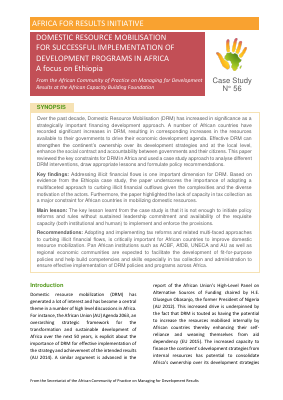
DOMESTIC RESOURCE MOBILISATION FOR SUCCESSFUL IMPLEMENTATION OF DEVELOPMENT PROGRAMS IN AFRICA A focus on Ethiopia
Open
- File Details
- Size: 25MB
- Creator / Author: Joan Addedis
- Resource Type: Africa Capacity Report
- # Download: 254
- Access: Open to Download
January, 2017
Download Files
AfCoPCaseStudy056.pdf
Basic Information
Creator / Author
ACBF
Source / Publisher
African Community of Practice on Management for Development result at the African Capacity Building Foundation (ACBF)
Number of Pages
10
Geographic & Audience Details
Geographic Coverage
Classification & Domains
Subject
DOMESTIC RESOURCE MOBILISATION
Abstract
Over the past decade, Domestic Resource Mobilisation (DRM) has increased in significance as a strategically important financing development approach. A number of African countries have recorded significant increases in DRM, resulting in corresponding increases in the resources available to their governments to drive their economic development agenda. Effective DRM can strengthen the continents ownership over its development strategies and at the local level, enhance the social contract and accountability between governments and their citizens. This paper reviewed the key constraints for DRM in Africa and used a case study approach to analyse different DRM interventions, draw appropriate lessons and formulate policy recommendations. Key findings: Addressing illicit financial flows is one important dimension for DRM. Based on evidence from the Ethiopia case study, the paper underscores the importance of adopting a multifaceted approach to curbing illicit financial outflows given the complexities and the diverse motivation of the actors. Furthermore, the paper highlighted the lack of capacity in tax collection as a major constraint for African countries in mobilizing domestic resources. Main lesson: The key lesson learnt from the case study is that it is not enough to initiate policy reforms and rules without sustained leadership commitment and availability of the requisite capacity (both institutional and human) to implement and enforce the provisions. Recommendations: Adopting and implementing tax reforms and related multi-faced approaches to curbing illicit financial flows, is critically important for African countries to improve domestic resource mobilization. Pan African institutions such as ACBF, AfDB, UNECA and AU as well as regional economic communities are expected to facilitate the development of fit-for-purpose policies and help build competencies and skills especially in tax collection and administration to ensure effective implementation of DRM policies and programs across Africa.
Keywords
Tax Reforms, Illicit Financial Flows, Public financial management (PFM) and procurement, Anti-money laundering framework, Tax administration
Login Required
Please log in or create an account to view and post comments.
Log In Register