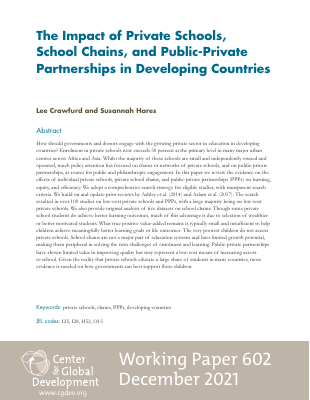
The Impact of Private Schools, School Chains, and Public-Private Partnerships in Developing Countries
Open
- File Details
- Size: 25MB
- Creator / Author: Joan Addedis
- Resource Type: Africa Capacity Report
- # Download: 254
- Access: Open to Download
January, 2022
Basic Information
Creator / Author
Lee Crawfurd, Susannah Hares
Source / Publisher
Center for Global Development
Resource Type
Number of Pages
32
Geographic & Audience Details
Classification & Domains
Abstract
How should governments and donors engage with the growing private sector in education in developing countries? Enrolment in private schools now exceeds 50 percent at the primary level in many major urban centres across Africa and Asia. Whilst the majority of these schools are small and independently owned and operated, much policy attention has focused on chains or networks of private schools, and on public-private partnerships, as routes for public and philanthropic engagement. In this paper we review the evidence on the effects of individual private schools, private school chains, and public-private partnerships (PPPs) on learning, equity, and efficiency. We adopt a comprehensive search strategy for eligible studies, with transparent search criteria. We build on and update prior reviews by Ashley et al. (2014) and Aslam et al. (2017). The search resulted in over 100 studies on low-cost private schools and PPPs, with a large majority being on low-cost private schools. We also provide original analysis of five datasets on school chains. Though some private school students do achieve better learning outcomes, much of this advantage is due to selection of wealthier or better motivated students. What true positive value-added remains is typically small and insufficient to help children achieve meaningfully better learning goals or life outcomes. The very poorest children do not access private schools. School chains are not a major part of education systems and have limited growth potential, making them peripheral in solving the twin challenges of enrolment and learning. Public-private partnerships have shown limited value in improving quality but may represent a low-cost means of increasing access to school. Given the reality that private schools educate a large share of students in many countries, more evidence is needed on how governments can best support these children. Keywords: private schools, chains, PPPs, developing countries
Keywords
private schools, chains, PPPs, developing countries
Login Required
Please log in or create an account to view and post comments.
Log In Register