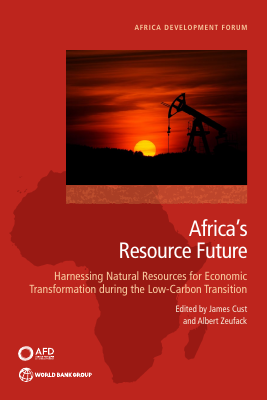
Africas Resource Future: Harnessing Natural Resources for Economic Transformation during the Low-Carbon Transition
Open
- File Details
- Size: 25MB
- Creator / Author: Joan Addedis
- Resource Type: Africa Capacity Report
- # Download: 254
- Access: Open to Download
January, 2023
Download Files
africa natural resorces future.pdf
Basic Information
Creator / Author
James Cust, Albert Zeufack
Source / Publisher
The World Bank
Number of Pages
274
Geographic & Audience Details
Classification & Domains
Subject
Harnessing Natural Resources for Economic Transformation during the Low-Carbon Transition
Abstract
This book examines the role for natural resource wealth in driving Africas economic transformation and the implications of the low-carbon transition for resource-rich economies. Resource wealth remains central to most Sub-Saharan African economies, and significant untapped potential is in the ground. Subsoil assetssuch as metals, minerals, oil, and gasare key sources of government revenues, export earnings, and development potential in most countries in the Africa region. Despite large reserves, success in converting subsoil wealth into aboveground sustainable prosperity has been limited. Since the decline in commodity prices in 2014, resource-rich Africa has grown more slowly than the regions average growth rate. Finding ways to more effectively harness natural resource wealth to drive economic transformation will be central to Africas economic future. As the world moves away from fossil fuels in alignment with commitments under the Paris Agreement, Africas resource-rich countries face new risks and opportunities. Recent estimates suggest that 80 percent of the worlds proven fossil fuel reserves must remain underground to meet the Paris targets, and much of these stranded reserves may be in Africa. This issue of stranded assets and, relatedly, stranded nations, has major implications for the many African economies that are dependent on petroleum extraction and export. On the other hand, the energy transition will increase demand for raw material inputs involved in clean energy technologies. The transition from fossil fuels to clean energy may create demand by 2050 for 3 billion tons of minerals and metals that are needed to deploy solar, wind, and geothermal energy. How can African economies tap into these opportunities while managing the downside risk to their fossil fuel wealth? "Africas Resource Future" explores these themes and offers policy makers insights to help them navigate the coming years of uncertainty.
Login Required
Please log in or create an account to view and post comments.
Log In Register