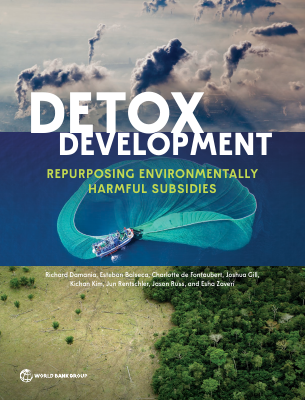
Detox Development: Repurposing Environmentally Harmful Subsidies
Research Papers
Open
- File Details
- Size: 25MB
- Creator / Author: Joan Addedis
- Resource Type: Africa Capacity Report
- # Download: 254
- Access: Open to Download
January, 2023
Download Files
detox.pdf
Basic Information
Creator / Author
Damania, Richard; Balseca, Esteban; de Fontaubert, Charlotte; Gill, Joshua; Kim, Kichan; Rentschler, Jun; Russ, Jason; Zaveri, Esha
Source / Publisher
World Bank
Resource Type
Number of Pages
307
Geographic & Audience Details
Classification & Domains
Subject
SUBSIDIES, CLEAN AIR, LAND, OCEANS
Abstract
Clean air, land, and oceans are critical for human health and nutrition and underpin much of the worlds economy. Yet they suffer from degradation, poor management, and overuse due to government subsidies. "Detox Development: Repurposing Environmentally Harmful Subsidies" examines the impact of subsidies on these foundational natural assets. Explicit and implicit subsidiesestimated to exceed US$7 trillion per yearnot only promote inefficiencies but also cause much environmental harm. Poor air quality is responsible for approximately 1 in 5 deaths globally. And as the new analyses in this report show, a significant number of these deaths can be attributed to fossil fuel subsidies. Agriculture is the largest user of land worldwide, feeding the world and employing 1 billion people, including 78 percent of the worlds poor. But it is subsidized in ways that promote inefficiency, inequity, and unsustainability. Subsidies are shown to drive the deterioration of water quality and increase water scarcity by incentivizing overextraction. In addition, they are responsible for 14 percent of annual deforestation, incentivizing the production of crops that are cultivated near forests. These subsidies are also implicated in the spread of zoonotic and vector-borne diseases, especially malaria. Finally, oceans support the worlds fisheries and supply about 3 billion people with almost 20 percent of their protein intake from animals. Yet they are in a collective state of crisis, with more than 34 percent of fisheries overfished, exacerbated by open-access regimes and capacity-increasing subsidies. Although the literature on subsidies is large, this report fills significant knowledge gaps using new data and methods. In doing so, it enhances understanding of the scale and impact of subsidies and offers solutions to reform or repurpose them in efficient and equitable ways. The aim is to enhance understanding of the magnitude, consequences, and drivers of policy successes and failures in order to render reforms more achievable.
Login Required
Please log in or create an account to view and post comments.
Log In Register