Africa's Second Half-Centenary: Sustainable Human Development/Citizen Security?
Research Papers
Open
- File Details
- Size: 25MB
- Creator / Author: Joan Addedis
- Resource Type: Africa Capacity Report
- # Download: 254
- Access: Open to Download
Download Files
File 093.pdf
Basic Information
Creator / Author
Shaw, Timothy. M
Resource Type
Geographic & Audience Details
Geographic Coverage
Classification & Domains
Subject
Development Policy
Abstract
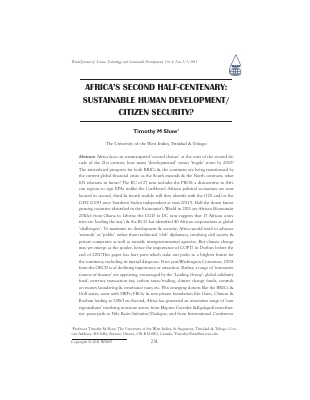
Africa faces an unanticipated second chance at the start of the second decade of the 21st century: how many developmental versus fragile states by 2020? The interrelated prospects for both BRICs & the continent are being transformed by the current global financial crisis: as the South expands & the North contracts, what S-N relations in future? The EU of 27 now includes the PIIGS: a disincentive to African regions to sign EPAs unlike the Caribbean? African political economies are now located in second, third & fourth worlds: will they identify with the G20 and/or the G192 (G193 once Southern Sudan independent at start 2011?). Half the dozen fastest growing countries identified in the Economists World in 2011 are African (Economist 2010a): from Ghana to Liberia; the CGD in DC now suggests that 17 African countries are leading the way; & the BCG has identified 40 African corporations as global challengers. To maximize its development & security, Africa would need to advance network or public rather than traditional club diplomacy, involving civil society & private companies as well as states& intergovernmental agencies. But climate change may yet emerge as the spoiler, hence the importance of COP17 in Durban before the end of 2011!This paper has four parts which stake out paths to a brighter future for the continent, including its myriad diasporas. First: post-Washington Consensus, ODA from the OECD is of declining importance or attraction. Rather, a range of innovative sources of finance are appearing, encouraged by the Leading Group: global solidarity fund, currency transaction tax, carbon taxes/trading, climate change funds, controls on money laundering & remittance taxes etc. Plus emerging donors like the BRICs & Gulf states, some with SWFs; FBOs; & new private foundation like Gates, Clinton & Ibrahim leading to GAVI etc.Second, Africa has generated an innovative range of new regionalisms involving non-state actors: from Maputo Corridor &Kgalagadi trans-frontier peace-park to Nile Basin Initiative/Dialogue; and from International Conference on the GLR to corporate supply chains.Third, new multilateralisms or transnational governance with African dimensions, from ICBL & Ottawa Process & PAC/GW & Kimberley Process & now DDI to EITI, FCS & MCS to IANSA & ATT; yet coalitions over SALW & children/womens security are stalled due to US vetoes. And finally, fourth, what implications of this trio of novel directions & players for our analyses & policies, state & non-state: who are the drivers, innovators & animators? How to transit from dependency & neoliberalism towards a Beijing Consensus? Where ACBF & its partners in 2030/2040/2050?
Keywords
Capacity Building, Development, Governance, Innovation, Public Diplomacy, ACBF 20th Anniversary Celebrations, Regionalisms, Varieties of Actors/Neworks
Login Required
Please log in or create an account to view and post comments.
Log In Register