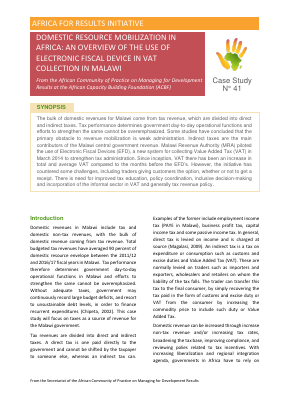
DOMESTIC RESOURCE MOBILIZATION IN AFRICA: AN OVERVIEW OF THE USE OF ELECTRONIC FISCAL DEVICE IN VAT COLLECTION IN MALAWI, Case Study No. 41
Ouvert
- Détails du fichier
- Size: 25MB
- Créateur / Auteur : Joan Addedis
- Type de ressource : Africa Capacity Report
- # Télécharger: 254
- Accéder: Open to Download
Télécharger des fichiers
AfCoPCaseStudy041.pdf
Informations de base
Créateur / Auteur
ACBF
Source / Éditeur
African Community of Practice on Management for Development result at the African Capacity Building Foundation (ACBF)
Détails géographiques et d'audience
Classification et domaines
Objet
DOMESTIC RESOURCE MOBILIZATION - MALAWI
Résumé
The bulk of domestic revenues for Malawi come from tax revenue, which are divided into direct and indirect taxes. Tax performance determines government day-to-day operational functions and efforts to strengthen the same cannot be overemphasized. Some studies have concluded that the primary obstacle to revenue mobilization is weak administration. Indirect taxes are the main contributors of the Malawi central government revenue. Malawi Revenue Authority (MRA) piloted the use of Electronic Fiscal Devices (EFD), a new system for collecting Value Added Tax (VAT) in March 2014 to strengthen tax administration. Since inception, VAT there has been an increase in total and average VAT compared to the months before the EFDs. However, the initiative has countered some challenges, including traders giving customers the option, whether or not to get a receipt. There is need for improved tax education, policy coordination, inclusive decision-making and incorporation of the informal sector in VAT and generally tax revenue policy.
Mots-clés
Electronic Fiscal Devices, Malawi Revenue Authority (MRA), Value Added Tax (VAT) - Malawi, Tax Revenue Policy - Malawi
Connexion requise
Veuillez vous connecter ou créer un compte pour consulter et publier des commentaires.
Se connecter S'inscrire