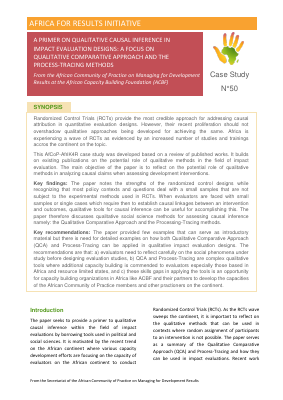
A PRIMER ON QUALITATIVE CAUSAL INFERENCE IN IMPACT EVALUATION DESIGNS: A FOCUS ON QUALITATIVE COMPARATIVE APPROACH AND THE PROCESS-TRACING METHODS, Case Study 50.
Ouvert
- Détails du fichier
- Size: 25MB
- Créateur / Auteur : Joan Addedis
- Type de ressource : Africa Capacity Report
- # Télécharger: 254
- Accéder: Open to Download
January, 2016
Télécharger des fichiers
AfCoPCaseStudy050.pdf
Informations de base
Créateur / Auteur
ACBF
Source / Éditeur
African Community of Practice on Management for Development result at the African Capacity Building Foundation (ACBF)
Nombre de pages
8
Détails géographiques et d'audience
Couverture géographique
Classification et domaines
Objet
IMPACT EVALUATION DESIGNS
Résumé
Randomized Control Trials (RCTs) provide the most credible approach for addressing causal attribution in quantitative evaluation designs. However, their recent proliferation should not overshadow qualitative approaches being developed for achieving the same. Africa is experiencing a wave of RCTs as evidenced by an increased number of studies and trainings accros the continent on the topic. This AfCoP-AfriK4R case study was developed based on a review of published works. It builds on existing publications on the potential role of qualitative methods in the field of impact evaluation. The main objective of the paper is to reflect on the potential role of qualitative methods in analyzing causal claims when assessing development interventions.
Mots-clés
Randomized Control Trials, Qualitative Comparative Approach (QCA), Process-Tracing
Connexion requise
Veuillez vous connecter ou créer un compte pour consulter et publier des commentaires.
Se connecter S'inscrire