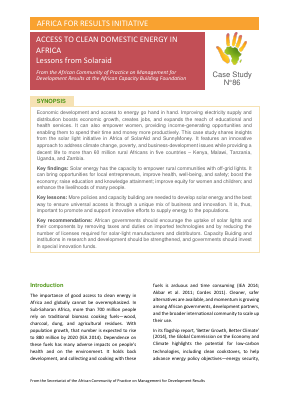
ACCESS TO CLEAN DOMESTIC ENERGY IN AFRICA Lessons from Solaraid
Ouvert
- Détails du fichier
- Size: 25MB
- Créateur / Auteur : Joan Addedis
- Type de ressource : Africa Capacity Report
- # Télécharger: 254
- Accéder: Open to Download
January, 2017
Télécharger des fichiers
AfCoPCaseStudy086.pdf
Informations de base
Créateur / Auteur
ACBF
Source / Éditeur
African Community of Practice on Management for Development result at the African Capacity Building Foundation (ACBF)
Nombre de pages
11
Détails géographiques et d'audience
Classification et domaines
Objet
Energy
Résumé
Economic development and access to energy go hand in hand. Improving electricity supply and distribution boosts economic growth, creates jobs, and expands the reach of educational and health services. It can also empower women, providing income-generating opportunities and enabling them to spend their time and money more productively. This case study shares insights from the solar light initiative in Africa of SolarAid and SunnyMoney. It features an innovative approach to address climate change, poverty, and business-development issues while providing a decent life to more than 60 million rural Africans in five countries Kenya, Malawi, Tanzania, Uganda, and Zambia. Key findings: Solar energy has the capacity to empower rural communities with off-grid lights. It can bring opportunities for local entrepreneurs, improve health, well-being, and safety; boost the economy; raise education and knowledge attainment; improve equity for women and children; and enhance the livelihoods of many people. Key lessons: More policies and capacity building are needed to develop solar energy and the best way to ensure universal access is through a unique mix of business and innovation. It is, thus, important to promote and support innovative efforts to supply energy to the populations. Key recommendations: African governments should encourage the uptake of solar lights and their components by removing taxes and duties on imported technologies and by reducing the number of licenses required for solar-light manufacturers and distributors. Capacity Buiding and institutions in research and development should be strengthened, and governments should invest in special innovation funds.
Mots-clés
Clear Energy, Economic development and Energy, Clean Fuel, Solar Energy, Solar industry
Connexion requise
Veuillez vous connecter ou créer un compte pour consulter et publier des commentaires.
Se connecter S'inscrire