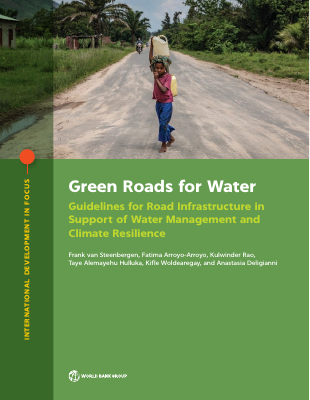
Green Roads for Water: Guidelines for Road Infrastructure in Support of Water Management and Climate Resilience
Annual Report
Ouvert
- Détails du fichier
- Size: 25MB
- Créateur / Auteur : Joan Addedis
- Type de ressource : Africa Capacity Report
- # Télécharger: 254
- Accéder: Open to Download
January, 2021
Informations de base
Créateur / Auteur
van Steenbergen, Frank; Arroyo-Arroyo, Fatima; Rao, Kulwinder; Hulluka, Taye Alemayehu; Woldearegay, Kifle; Deligianni, Anastasia.
Source / Éditeur
International Development in Focus; World Bank.
Type de ressource
Nombre de pages
265
Détails géographiques et d'audience
Classification et domaines
Résumé
Roads and water are generally seen as enemies, with water responsible for most of the damage to roads, and roads being a major cause of problems such as erosion, waterlogging, flooding, and dust storms. This tension, however, can be reversed. The concept of Green Roads for Water (also known as Green Roads or roads for water) places roads in the service of water and landscape management and climate resilience without sacrificing or diminishing their transport functions. With global investment in roads of US$1US$2 trillion per year, plus maintenance costs, the widespread adoption of Green Roads approaches can leverage investment at a transformative scale, making road development and maintenance a vital tool for achieving climate resilience, water security, and productive use of natural resources. Green Roads for Water: Guidelines for Road Infrastructure in Support of Water Management and Climate Resilience provides strategies to use roads for beneficial water management tailored to diverse landscapes and climates, including watershed areas, semiarid climates, coastal lowlands, mountainous areas, and floodplains. The underlying premise of Green Roads is therefore quite simple: designing roads to fit their natural and anthropomorphic contexts; minimize externalities; and balance preservation of the road, water resources, landscape, and soil resources will usually cost less than traditional protective resilience approaches and will produce more sustainable overall outcomes.
Connexion requise
Veuillez vous connecter ou créer un compte pour consulter et publier des commentaires.
Se connecter S'inscrire