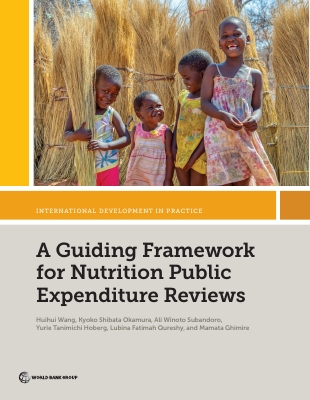
A Guiding Framework for Nutrition Public Expenditure Reviews
Ouvert
- Détails du fichier
- Size: 25MB
- Créateur / Auteur : Joan Addedis
- Type de ressource : Africa Capacity Report
- # Télécharger: 254
- Accéder: Open to Download
January, 2022
Télécharger des fichiers
A Guiding Framework.pdf
Informations de base
Créateur / Auteur
Huihui Wang, Kyoko Shibata Okamura, Ali Winoto Subandoro, Yurie Tanimichi Hoberg, Lubina Fatimah Qureshy, and Mamata Ghimire
Source / Éditeur
World Bank
Nombre de pages
85
Détails géographiques et d'audience
Classification et domaines
Résumé
Nutrition investments affect human capital formation, which in turn affects economic growth. Malnutrition is intrinsically connected to human capitalundernutrition contributes to nearly half of child mortality, and stunting reduces productivity and earnings in adulthood. Improving nutrition requires a multisectoral effort, but it is difficult to identify and quantify the basic financing parameters as used in traditional sectors. What is being spent and by whom and on what? To address these questions, nutrition public expenditure reviews (NPERs) determine the level of a countrys overall nutrition public spending and assess whether its expenditure profile will enable the country to realize its nutrition goals and objectives. When done well, NPERs go beyond simply quantifying how much is spent on nutrition; they measure how well money is being spent to achieve nutrition outcomes and identify specific recommendations for improvement. A Guiding Framework for Nutrition Public Expenditure Reviews presents the key elements of an NPER and offers guidance, practical steps, and examples for carrying out an NPER. The book draws upon good practices from past NPERs as well as common practices and expertise from public expenditure reviews in other sectors. This handbook is intended for practitioners who are tasked with carrying out NPERs. Other target audiences include country nutrition policy makers, development partner officials, government technical staff, and nutrition advocates. The book presents data and analytical challenges faced by previous NPER teams and lays out the kinds of analyses that past NPERs have been able to carry out and those that they were unable to perform because of data or capacity constraints. It concludes with further work needed at the global and country levels to create the conditions necessary to conduct more comprehensive NPERs.
Connexion requise
Veuillez vous connecter ou créer un compte pour consulter et publier des commentaires.
Se connecter S'inscrire