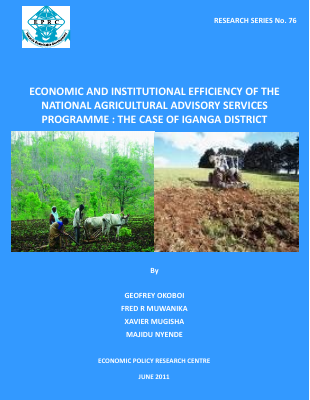
ECONOMIC AND INSTITUTIONAL EFFICIENCY OF THE NATIONAL AGRICULTURAL ADVISORY SERVICES PROGRAMME : THE CASE OF IGANGA DISTRICT
Ouvert
- Détails du fichier
- Size: 25MB
- Créateur / Auteur : Joan Addedis
- Type de ressource : Africa Capacity Report
- # Télécharger: 254
- Accéder: Open to Download
Télécharger des fichiers
EPRCseries76.pdf
Informations de base
Créateur / Auteur
GEOFREY OKOBOI, FRED R MUWANIKA, XAVIER MUGISHA, MAJIDU NYENDE
Source / Éditeur
Economic Policy Research Centre (EPRC)
Type de ressource
Détails géographiques et d'audience
Classification et domaines
Objet
Agriculture
Résumé
This paper examines the technical and institutional efficiency of the National Agricultural Advisory Services (NAADS) programme implementation in Iganga district. The Cost Effective Analysis (CEA) and stochastic frontier analysis methods were used to examine technical efficiency while expenditure tracking and Focus Group Discussion (FGD) methods were applied to assess institutional efficiency. The analysis demonstrates that NAADS interventions have not had a significant impact on the output, productivity and income of the farmers in Iganga district. Moreover, NAADS programme faces implementation weaknesses such as nepotism that affects the selection of beneficiaries as well as enterprises, to the extent that some farmers are apathetic about the success or failure of NAADS Programme. Other observed weaknesses in NAADS implementation include late disbursement of funds, very low counterpart funding by the local government and the farmers, and poor monitoring and evaluation (M&E) of the programme. Based on the results, we suggest a major review of the implementation process of NAADS programme in general and Iganga district NAADS in particular.
Mots-clés
Agricultural Research, Economic Growth
Connexion requise
Veuillez vous connecter ou créer un compte pour consulter et publier des commentaires.
Se connecter S'inscrire