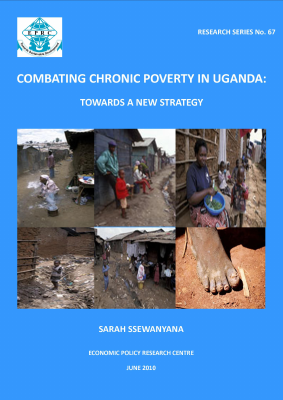
COMBATING CHRONIC POVERTY IN UGANDA: TOWARDS A NEW STRATEGY
Ouvert
- Détails du fichier
- Size: 25MB
- Créateur / Auteur : Joan Addedis
- Type de ressource : Africa Capacity Report
- # Télécharger: 254
- Accéder: Open to Download
Télécharger des fichiers
EPRCseries67.pdf
Informations de base
Créateur / Auteur
SSEWANYANA, Sarah
Source / Éditeur
Economic Policy Research Centre (EPRC)
Type de ressource
Détails géographiques et d'audience
Classification et domaines
Objet
Poverty Reduction
Résumé
Using a panel of 3,572 households in the Northern Uganda Social Action Fund (NUSAF) region interviewed in 2004 and in 2008, the paper provides new evidence on chronic poverty in Uganda. While progress in reducing poverty rates has been impressive from 64.6 percent to 52.2 percent, the levels remain high with a significant number of persistently poor households. Four in every ten households are chronically poor of which 44.9 percent are living in extreme chronic poverty. About 37.8 percent of the households are living in transient poverty of which 67.4 percent escaped poverty during the panel period. The substantial movements out of poverty can perhaps be explained largely by the relative return of peace in the region that enabled households to engage in agricultural activities. While at the aggregate level chronic poverty is significantly more prevalent than transient poverty, a mixed picture is observed at disaggregated level. The picture at aggregate level mirrors itself in the sub-regions of West Nile and Karamoja; but the reverse is observed in Lango sub-region. Chronic poverty is as equally prevalent as transient poverty in Acholi and Teso sub-regions. Overall, chronic poverty is disproportionately high among the Karamajongs. This calls for different kinds of anti-poverty interventions and public support. The paper further demonstrates that the characteristics and determinants of chronic and transient poverty are not always the same. The chronically poor households suffer from multidimensional deprivation including low incomes, low human capital development, inadequate access to infrastructure (especially input markets, trunk roads etc), and inability to access non-agricultural employment. On the other hand, the findings have demonstrated that ensuring peace in this part of the country is necessary for sustainable poverty reduction.
Mots-clés
Chronic Poverty, Poverty Dynamic
Connexion requise
Veuillez vous connecter ou créer un compte pour consulter et publier des commentaires.
Se connecter S'inscrire