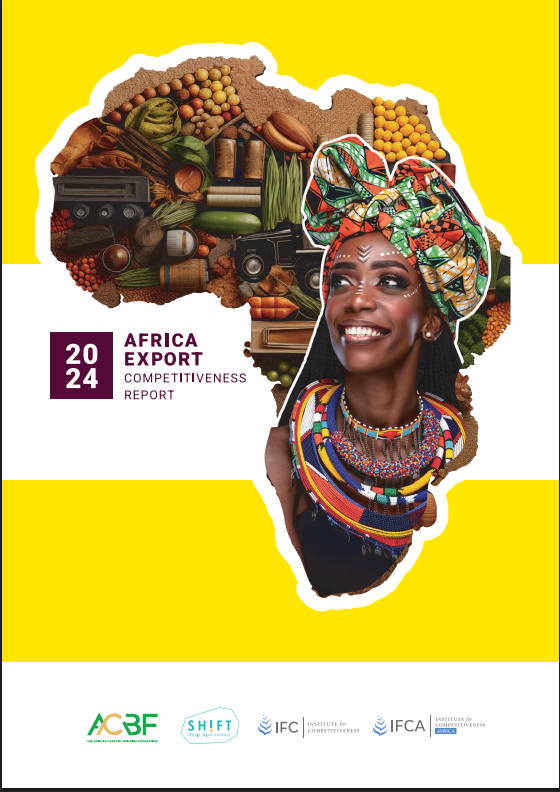
2024 Africa Export Competitiveness Report
Open
- File Details
- Size: 25MB
- Creator / Author: Joan Addedis
- Resource Type: Africa Capacity Report
- # Download: 254
- Access: Open to Download
January, 2025
Download Files
AEC Report 2024 Online.pdf
Basic Information
Creator / Author
Amit Kapoor, Barassou Diawara, Kartik
Source / Publisher
African Capacity Building Foundation, Institute for Competitiveness, India, Shift Impact Africa & Institute for Competitiveness Africa
Content Type
Number of Pages
105
Geographic & Audience Details
Classification & Domains
Subject
Export, AfCFTA Agreement implementation, complementary measures, AfCFTA operational tools, Pan African Payment and Settlement System (PAPSS), cross-border payments, trade cost reduction, e-tariff book, non-tariff barriers reporting platform, rules of origin manual, private sector engagement, public sector engagement, women’s integration into trade, regional value chains, trade-related regulations, customs procedures, supply capacity building, value addition techniques, physical infrastructure investment, soft infrastructure investment, education, technology, trade facilitation, legal and regulatory harmonisation, stakeholder guidance, inclusive economic growth, African market integration, African Capacity Building Foundation (ACBF), Shift Impact Africa, African Competitiveness Institute, indigenised African research.
Abstract
The Africa Export Competitiveness Report 2024 presents a comprehensive evaluation of the continent’s export landscape, offering critical insights into performance, challenges, and opportunities for growth. In 2023, Africa recorded a GDP growth of 3.2% and a notable 7.2% rise in intra-African trade, totaling $192 billion. Despite these gains, Africa’s global merchandise export share remains disproportionately low at 2.67%, underscoring the urgent need for product and market diversification. Central to the report is the Africa Export Competitiveness Index (AECI), which assesses 40 countries across four key pillars: Enabling Environment, Demand Sophistication, Business Dynamism, and Export Performance. South Africa, Morocco, and Mauritius top the index, yet only 17 countries exceed the average score of 34.65, revealing widespread structural barriers to export growth. The report identifies inadequate infrastructure and complex regulatory frameworks as major impediments to competitiveness. It advocates for targeted investments in infrastructure, education, and technology to foster sustainable development. A significant focus is placed on gender inclusion, highlighting that women—who comprise 60–70% of informal cross-border traders—contribute only 20% of export value. The report calls for gender-responsive policies, especially through the AfCFTA Protocol on Women and Youth in Trade, to empower women and enhance their participation in formal trade. Concluding with strategic recommendations, the report urges improvements in export policy, infrastructure development, and inclusive trade frameworks. By addressing these systemic challenges, Africa can strengthen its global trade position and drive inclusive, sustainable economic growth across the continent.
Keywords
AfCFTA Agreement implementation, complementary measures, AfCFTA operational tools, Pan African Payment and Settlement System (PAPSS), cross-border payments, trade cost reduction, e-tariff book, non-tariff barriers reporting platform, rules of origin manual, private sector engagement, public sector engagement, women’s integration into trade, regional value chains, trade-related regulations, customs procedures, supply capacity building, value addition techniques, physical infrastructure investment, soft infrastructure investment, education, technology, trade facilitation, legal and regulatory harmonisation, stakeholder guidance, inclusive economic growth, African market integration, Africa Export Competitiveness Report, Africa Export Competitiveness Index (AECI), export performance, geographic coverage expansion, manufacturing capacity, export competitiveness, strategic Call to Action, Agenda 2063, transformative tools, economic liberalism, single continental market, global integration, geo-political headwinds
Login Required
Please log in or create an account to view and post comments.
Log In Register