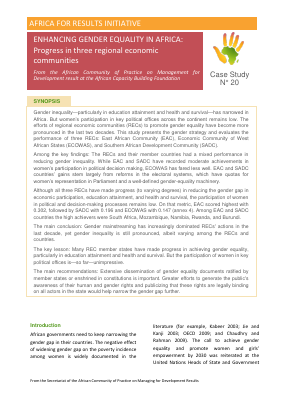
ENHANCING GENDER EQUALITY IN AFRICA: Progress in three regional economic communities, Case Study No. 20
Open
- File Details
- Size: 25MB
- Creator / Author: Joan Addedis
- Resource Type: Africa Capacity Report
- # Download: 254
- Access: Open to Download
Download Files
AfCoPCaseStudy020.pdf
Basic Information
Creator / Author
ACBF
Source / Publisher
African Community of Practice on Management for Development result at the African Capacity Building Foundation (ACBF)
Geographic & Audience Details
Geographic Coverage
Classification & Domains
Subject
Gender Equality
Abstract
Gender inequalityparticularly in education attainment and health and survivalhas narrowed in Africa. But womens participation in key political offices across the continent remains low. The efforts of regional economic communities (RECs) to promote gender equality have become more pronounced in the last two decades. This study presents the gender strategy and evaluates the performance of three RECs: East African Community (EAC), Economic Community of West African States (ECOWAS), and Southern African Development Community (SADC). Among the key findings: The RECs and their member countries had a mixed performance in reducing gender inequality. While EAC and SADC have recorded moderate achievements in womens participation in political decision making, ECOWAS has fared less well. EAC and SADC countries gains stem largely from reforms in the electoral systems, which have quotas for womens representation in Parliament and a well-defined gender-equality machinery. Although all three RECs have made progress (to varying degrees) in reducing the gender gap in economic participation, education attainment, and health and survival, the participation of women in political and decision-making processes remains low. On that metric, EAC scored highest with 0.302, followed by SADC with 0.196 and ECOWAS with 0.147 (annex 4). Among EAC and SADC countries the high achievers were South Africa, Mozambique, Namibia, Rwanda, and Burundi. The main conclusion: Gender mainstreaming has increasingly dominated RECs' actions in the last decade, yet gender inequality is still pronounced, albeit varying among the RECs and countries. The key lesson: Many REC member states have made progress in achieving gender equality, particularly in education attainment and health and survival. But the participation of women in key political offices isso farunimpressive. The main recommendations: Extensive dissemination of gender equality documents ratified by member states or enshrined in constitutions is important. Greater efforts to generate the public's awareness of their human and gender rights and publicizing that these rights are legally binding on all actors in the state would help narrow the gender gap further.
Keywords
Gender and Regional Economic Communities, Regional Economic Communities, East African Community (EAC), Economic Community of West African States (ECOWAS), Southern African Development Community (SADC)
Login Required
Please log in or create an account to view and post comments.
Log In Register