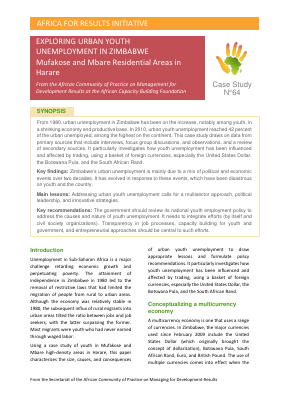
EXPLORING URBAN YOUTH UNEMPLOYMENT IN ZIMBABWE Mufakose and Mbare Residential Areas in Harare
Open
- File Details
- Size: 25MB
- Creator / Author: Joan Addedis
- Resource Type: Africa Capacity Report
- # Download: 254
- Access: Open to Download
January, 2017
Download Files
AfCoPCaseStudy064.pdf
Basic Information
Creator / Author
ACBF
Source / Publisher
ACBF
Number of Pages
8
Geographic & Audience Details
Classification & Domains
Subject
Youth Employment
Abstract
From 1980, urban unemployment in Zimbabwe has been on the increase, notably among youth, in a shrinking economy and productive base. In 2010, urban youth unemployment reached 42 percent of the urban unemployed, among the highest on the continent. This case study draws on data from primary sources that include interviews, focus group discussions, and observations, and a review of secondary sources. It particularly investigates how youth unemployment has been influenced and affected by trading, using a basket of foreign currencies, especially the United States Dollar, the Botswana Pula, and the South African Rand. Key findings: Zimbabwes urban unemployment is mainly due to a mix of political and economic events over two decades. It has evolved in response to these events, which have been disastrous on youth and the country. Main lessons: Addressing urban youth unemployment calls for a multisector approach, political leadership, and innovative strategies. Key recommendations: The government should review its national youth employment policy to address the causes and nature of youth unemployment. It needs to integrate efforts (by itself and civil society organizations). Transparency in job processes, capacity building for youth and government, and entrepreneurial approaches should be central to such efforts.
Keywords
Youth Unemployment, Multicurrency economy, Youth unemployment in Zimbabwe, urban youth unemployment
Login Required
Please log in or create an account to view and post comments.
Log In Register