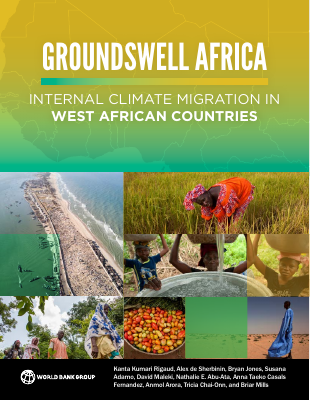
Groundswell Africa : Internal Climate Migration in West African Countries
Open
- File Details
- Size: 25MB
- Creator / Author: Joan Addedis
- Resource Type: Africa Capacity Report
- # Download: 254
- Access: Open to Download
January, 2021
Download Files
Full Report West Africa.pdf
Basic Information
Creator / Author
Rigaud, Kanta Kumari; de Sherbinin, Alex; Jones, Bryan; Adamo, Susana; Maleki, David; Abu-Ata, Nathalie E.; Casals Fernandez, Anna Taeko; Arora, Anmol; Chai-Onn, Tricia; Mills, Briar
Source / Publisher
World Bank
Number of Pages
296
Geographic & Audience Details
Classification & Domains
Subject
Climate change
Abstract
This report, as part of the Groundswell Africa series, reaffirms the potency for climate change to drive internal migration in West African countries. The results described in this report are based on the application of an enhanced version of the pioneering Groundswell model with a more granular analysis and additional features better placed to inform policy dialogue and action. The study finds that without concrete climate and development action, up to 32 million people in West Africa could be compelled to move within their countries by 2050 as a consequence of slow onset climate impacts in response to water scarcity, declines in crop productivity and ecosystem productivity, and sea level rise, augmented by storm surge. The analysis also includes consideration of nonclimate factors. The countries will see an emergence of climate in- and climate out-migration hotspots, as early as 2030, but with continued spread and intensification by 2050. These numbers are not predestinedand could be reduced at the regional level by about 60 percent with concrete climate and development action. Niger, Nigeria, and Senegal are projected to have the highest numbers of internal climate migrants by 2050: reaching a high of 19.1 million, 9.4 million, and 1.0 million, respectively, under the pessimistic scenario. A special focus on the 5-kilometer coastal zone of West Africa reveals that between 0.3 million and 2.2 million people could be compelled to move within their countries just for this coastal belt by 2050. This report presents the Migration and Climate-informed Solutions (MACS) framework that brings together domains of action, buttressed by core policy areas, to reduce the scale of climate-induced migration, usher in social and economic transformations, and reduce vulnerabilities. This anticipatory approach will ensure that West African countries are braced not just for the challenges but have the readiness to harness the opportunities of internal climate migration. The urgency to reduce greenhouse gases remains paramount to reduce the scale of climate impacts that could otherwise drive increased levels of climate migration the window of opportunity is rapidly narrowing.
Keywords
West African Countries, Africa
Login Required
Please log in or create an account to view and post comments.
Log In Register