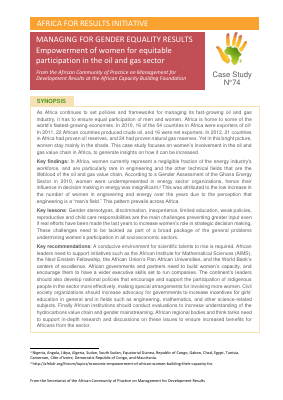
MANAGING FOR GENDER EQUALITY RESULTS Empowerment of women for equitable participation in the oil and gas sector
Open
- File Details
- Size: 25MB
- Creator / Author: Joan Addedis
- Resource Type: Africa Capacity Report
- # Download: 254
- Access: Open to Download
January, 2017
Download Files
AfCoPCaseStudy074.pdf
Basic Information
Creator / Author
ACBF
Source / Publisher
African Community of Practice on Management for Development result at the African Capacity Building Foundation (ACBF)
Number of Pages
10
Geographic & Audience Details
Geographic Coverage
Classification & Domains
Subject
Gender Equality
Abstract
As Africa continues to set policies and frameworks for managing its fast-growing oil and gas industry, it has to ensure equal participation of men and women. Africa is home to some of the worlds fastest-growing economies. In 2010, 16 of the 54 countries in Africa were exporters of oil1 In 2011, 22 African countries produced crude oil, and 16 were net exporters. In 2012, 21 countries in Africa had proven oil reserves, and 24 had proven natural gas reserves. Yet in this bright picture, women stay mainly in the shade. This case study focuses on womens involvement in the oil and gas value chain in Africa, to generate insights on how it can be increased. Key findings: In Africa, women currently represent a negligible fraction of the energy industry's workforce, and are particularly rare in engineering and the other technical fields that are the lifeblood of the oil and gas value chain. According to a Gender Assessment of the Ghana Energy Sector in 2010, women were underrepresented in energy sector organizations, hence their influence in decision making in energy was insignificant.2 This was attributed to the low increase in the number of women in engineering and energy over the years due to the perception that engineering is a mans field. This pattern prevails across Africa. Key lessons: Gender stereotypes, discrimination, inexperience, limited education, weak policies, reproductive and child care responsibilities are the main challenges preventing greater input even if real efforts have been made the last years to increase womens role in strategic decision making, These challenges need to be tackled as part of a broad package of the general problems undermining womens participation in all socioeconomic sectors. Key recommendations: A conducive environment for scientific talents to rise is required. African leaders need to support initiatives such as the African Institute for Mathematical Sciences (AIMS), the Next Einstein Fellowship, the African Unions Pan African Universities, and the World Banks centers of excellence. African governments and partners need to build womens capacity, and encourage them to have a wider executive skills set to run companies. The continents leaders should also develop national policies that encourage and support the participation of indigenous people in the sector more effectively, making special arrangements for involving more women. Civil society organizations should increase advocacy for governments to increase incentives for girls education in general and in fields such as engineering, mathematics, and other science-related subjects. Finally African institutions should conduct evaluations to increase understanding of the hydrocarbons value chain and gender mainstreaming. African regional bodies and think tanks need to support in-depth research and discussions on these issues to ensure increased benefits for Africans from the sector.
Keywords
Women Empowerment, Women in oil and gas sector, Women in Energy Industry
Login Required
Please log in or create an account to view and post comments.
Log In Register