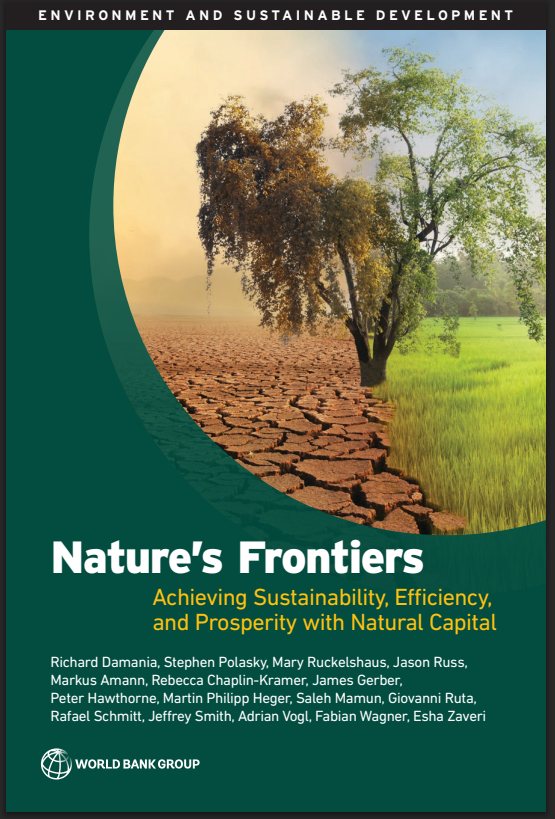
Nature's Frontiers: Achieving Sustainability, Efficiency, and Prosperity with Natural Capital
Open
- File Details
- Size: 25MB
- Creator / Author: Joan Addedis
- Resource Type: Africa Capacity Report
- # Download: 254
- Access: Open to Download
January, 2023
Download Files
nature.pdf
Basic Information
Creator / Author
Damania, Richard; Polasky, Stephen; Ruckelshaus, Mary; Russ, Jason; Amann, Markus; Chaplin-Kramer, Rebecca; Gerber, James; Hawthorne, Peter; Heger, Martin Philipp; Mamun, Saleh; Ruta, Giovanni; Schmitt, Rafael; Smith, Jeffrey; Vogl, Adrian; Wagner, Fabian
Source / Publisher
World Bank
Content Type
Geographic & Audience Details
Classification & Domains
Subject
The Environment and Sustainable Development series covers current and emerging issues that are central to reducing poverty through better management of natural resources, pollution control, and climate-resilient growth.
Abstract
The great expansion of economic activity since the end of World War II has caused an unprecedented rise in living standards, but it has also caused rapid changes in earth systems. Nearly all types of natural capital—the world’s stock of resources and services provided by nature—are in decline. Clean air, abundant and clean water, fertile soils, productive fisheries, dense forests, and healthy oceans are critical for healthy lives and healthy economies. Mounting pressures, however, suggest that the trend of declining natural capital may cast a long shadow into the future. "Nature’s Frontiers: Achieving Sustainability, Efficiency, and Prosperity with Natural Capital" presents a novel approach to address these foundational challenges of sustainability. A methodology combining innovative science, new data sources, and cutting-edge biophysical and economic models builds sustainable resource efficiency frontiers to assess how countries can sustainably use their natural capital more efficiently. The analysis provides recommendations on how countries can better use their natural capital to achieve their economic and environ mental goals. The report indicates that significant efficiency gaps exist in nearly every country. Closing these gaps can address many of the world’s pressing economic and environmental problems—economic productivity, health, food and water security, and climate change. Although the approach outlined in this report will entail demanding policy reforms, the costs of inaction will be far higher.
Keywords
Climate change, nature
Login Required
Please log in or create an account to view and post comments.
Log In Register