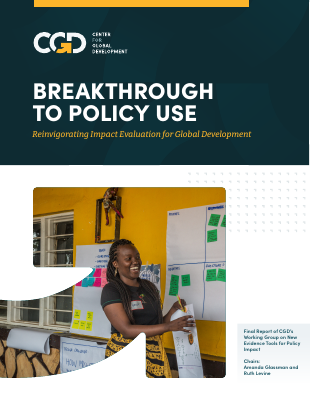
Taking Stock of Organizations with Impact Evaluation Capacity Headquartered in sub-Saharan Africa: A New Database and Landscaping Analysis
Open
- File Details
- Size: 25MB
- Creator / Author: Joan Addedis
- Resource Type: Africa Capacity Report
- # Download: 254
- Access: Open to Download
January, 2023
Download Files
reinvigorating-impact-evaluation-for-global-development.pdf
Basic Information
Creator / Author
Julia Kaufman , Justin Hurley , Janeen Madan Keller and Erin Collinson
Source / Publisher
Center for Glabal Development
Number of Pages
48
Geographic & Audience Details
Classification & Domains
Abstract
The evidence-informed policy ecosystem has evolved significantly over the past two decades. Alongside an increase in the number of impact evaluations, the community of researchers and organizations in low- and middle-income countries conducting these studies continues to grow. Locally immersed researchers can help increase the policy use and utility of impact evaluation and related evidence, bringing critical insight on the priorities of policymakers and windows of opportunity to inform decision-making. Still, despite their vital role, many locally immersed research organizations encounter chronic funding challenges and other institutional and professional barriers. CGD conducted a landscaping exercise to better understand the current landscape of organizations headquartered in sub-Saharan Africa that boast impact evaluation capacity. The resulting database is intended as a resource for funders looking to advance locally led development; to help facilitate coordination and networking; and to advance opportunities for collaboration among researchers, program implementers, policymakers, and funders. We found that the number of organizations headquartered in sub-Saharan Africa with impact evaluation capacity has increased over recent years. We identified 181 unique African organizationswith impact evaluation capacity, representing a 26 percent increase since 2019. These organizations are distributed across the region, with the largest concentration in East Africa. A significant portion has received or currently receives US government support, though often indirectly, providing potential openings for deepening partnerships with locally led organizations. Finally, a wide range of types of organizations have impact evaluation capacityindependent think tanks/NGOs, academic institutions, and government-embedded or adjacent entities.
Login Required
Please log in or create an account to view and post comments.
Log In Register