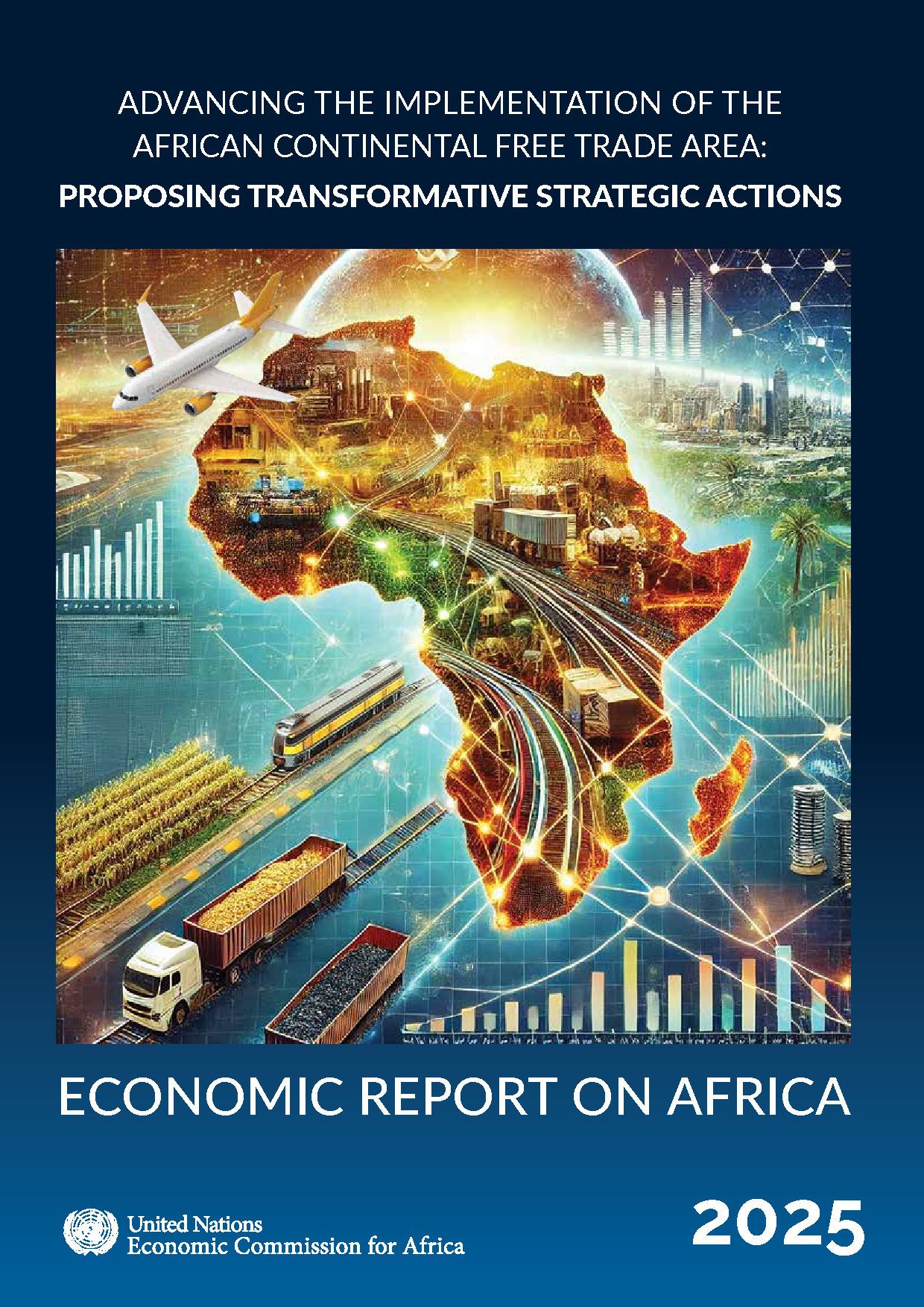
Economic Report on Africa 2025: Advancing the Implementation of the Agreement Establishing the African Continental Free Trade Area: Proposing Transformative Strategic Actions
- File Details
- Size: 25MB
- Creator / Author: Joan Addedis
- Resource Type: Africa Capacity Report
- # Download: 254
- Access: Open to Download
March, 2026
Basic Information
Creator / Author
United Nations Economic Commission for Africa (ECA)
Source / Publisher
United Nations Economic Commission for Africa (ECA)
Resource Type
Content Type
Number of Pages
148
Geographic & Audience Details
Classification & Domains
Subject
African Continental Free Trade Area, AfCFTA, intra-African trade, regional integration, trade liberalization, non-tariff barriers, industrialization, economic transformation, structural transformation, infrastructure investment, digitalization, sustainable development, Agenda 2063, economic growth, fiscal policy, public debt, poverty reduction, gender equality, youth employment, urbanization, climate change, renewable energy, food security, MSMEs, public-private partnerships, trade facilitation, regional value chains, foreign direct investment, regulatory harmonization, customs procedures, energy transition, carbon pricing, informal cross-border trade, special economic zones, de-risking, African Union, United Nations Economic Commission for Africa, Africa
Theme
Rights & License
Rights / License
United Nations
Abstract
The Economic Report on Africa 2025 (ERA 2025) assesses the implementation of the African Continental Free Trade Area (AfCFTA) and proposes transformative strategic actions to accelerate its success. Despite Africa's economic rebound from the COVID-19 pandemic, growth remains below pre-pandemic levels and insufficient to achieve the Sustainable Development Goals (SDGs). The report provides empirical evidence demonstrating the AfCFTA's potential to drive Africa's trade-led integration, boost intra-African trade by approximately 45% (or $275.7 billion) by 2045, and increase Africa's GDP by 1.2% (or $140.6 billion) in the same period. Key findings indicate that the AfCFTA can support climate-resilient development, enhance food security, promote industrialization, and strengthen regional value chains. The report identifies critical enablers including investment in transport infrastructure ($120.83 billion required by 2030), digitalization, regulatory harmonization, and inclusive private sector engagement. It also highlights financing strategies, de-risking mechanisms, and the need for national reforms to domesticate the AfCFTA agreement. The report concludes with actionable recommendations for policymakers, governments, development partners, and the private sector to bridge implementation gaps and realize the AfCFTA's transformative potential in line with Agenda 2063: The Africa We Want.
Keywords
African Economic Outlook, African Continental Free Trade Area, AfCFTA, Africa, economic growth, intra-African trade, regional integration, industrialization, structural transformation, trade facilitation, tariff liberalization, non-tariff barriers, infrastructure investment, digitalization, sustainable development, fiscal policy, public debt, debt sustainability, domestic resource mobilization, financial architecture, capital mobilization, climate change, renewable energy, food security, poverty reduction, gender equality, youth employment, urbanization, MSMEs, public-private partnerships, foreign direct investment, official development assistance, remittances, regional value chains, global value chains, economic diversification, regulatory harmonization, customs procedures, energy transition, carbon pricing, informal cross-border trade, special economic zones, de-risking, Agenda 2063, African Union, United Nations Economic Commission for Africa, African Development Bank


Login Required
Please log in or create an account to view and post comments.
Log In Register